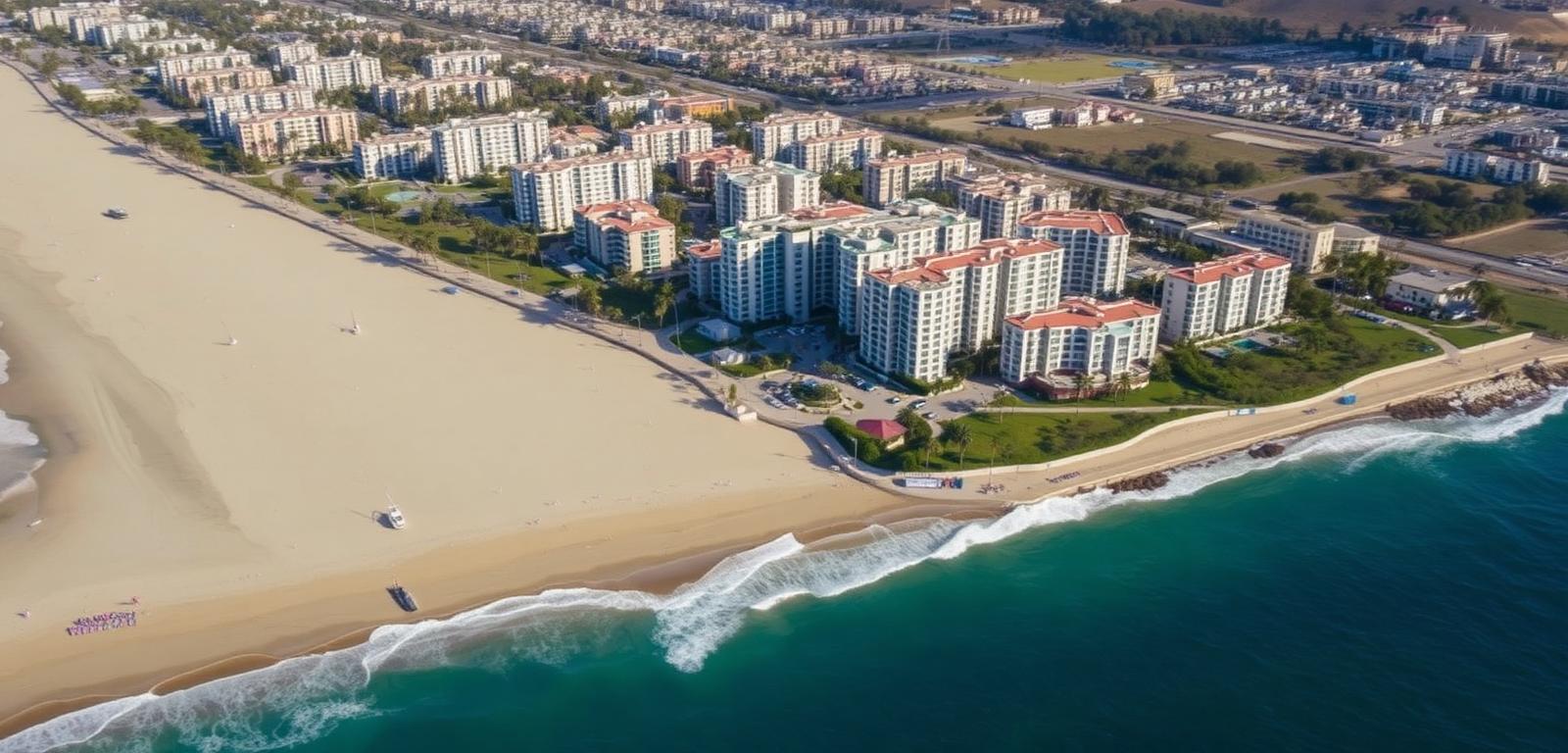
Welcome to this comprehensive guide on the Hermosa Beach multifamily market. My name is David Messiah, a multifamily advisory specialist at Lyon Stahl Investment Real Estate. Over the years, I have had the privilege of working alongside countless property owners and investors across the Los Angeles coastal and Westside markets. Our coverage map spans a wide array of submarkets, and we advise clients daily in Santa Monica, Venice, Mar Vista, Westchester, West LA, Brentwood, Westwood, Culver City, Palms, Beverly Hills, El Segundo, Manhattan Beach, Hermosa Beach, Redondo Beach, Torrance, Hawthorne, Gardena, Lawndale, Lomita, Carson, Rancho Palos Verdes, Rolling Hills, Rolling Hills Estates, and Palos Verdes Estates.
While every one of these submarkets offers unique opportunities, Hermosa Beach stands apart as a crown jewel in the South Bay. Characterized by its laid-back surf culture, immediate beach access, and highly affluent renter demographic, it is a market where capital preservation and long-term appreciation often outshine day-one cash flow. My approach as an advisor is always no-pressure and options-first. I believe that an informed owner is an empowered owner. Whether you are looking to maximize your current rental income, explore a refinance to fund upgrades, or transition your equity into a higher-yielding asset, understanding the granular data of your local market is the essential first step.
This guide is designed to provide you with an authoritative, plain-English overview of the Hermosa Beach multifamily landscape. We will explore current rent benchmarks, dissect cap rates and valuation metrics, decode the regulatory environment, and discuss actionable strategies to maximize your return on equity.
Market Overview and Current Rent Benchmarks
- Inventory is dominated by boutique properties (duplexes, triplexes, and 4-to-10 unit assets).
- Virtually no large institutional developments exist due to highly restrictive coastal zoning laws.
- Median asking rents range from $3,400 to $4,200 per month, varying heavily by proximity to the beach and unit condition.
- 1-bedroom units consistently rent between $2,700 and $3,600 per month.
- 2-bedroom units command $3,900 to $5,400+ per month.
- 3-bedroom and larger units stretch from $5,800 to well over $8,500 per month.
- Price per square foot for rent often exceeds $4.25 to $5.50 for newly renovated units situated near The Strand.
Hermosa Beach represents one of the most desirable and highest-barrier-to-entry coastal submarkets in all of Los Angeles County. Unlike vast inland stretches of Los Angeles where 50-to-100-unit institutional apartment buildings are common, Hermosa Beach's multifamily inventory is almost exclusively made up of boutique, smaller-scale properties. The vast majority of the rental stock consists of duplexes, triplexes, and intimate 4-to-10 unit apartment buildings. This low-density charm is fiercely protected by restrictive coastal zoning and municipal building codes, meaning new supply is virtually nonexistent. For current owners, this severe lack of new construction acts as an incredible protective moat around your property's value.
Because supply is so constrained and demand remains perpetually high, Hermosa Beach commands some of the most premium rental rates in Southern California. The tenant demographic here is exceptional. The renter pool is largely comprised of high-earning tech professionals, aerospace and defense executives commuting to nearby El Segundo, Manhattan Beach, and Hawthorne, and lifestyle renters who place a massive premium on walkability and immediate access to the Pacific Ocean.
When we look at the data, the rent benchmarks are staggering. Even entry-level one-bedroom units rarely rent for less than $2,700, and fully renovated one-bedrooms easily eclipse $3,600. For larger units, the sky is the limit. Two-bedroom units routinely secure over $5,000 if they feature ocean views, parking, and modern amenities. Three-bedroom units, which often feel like single-family homes, can push past $8,500 per month. On a price-per-square-foot basis, owners of renovated units near The Strand are achieving $4.25 to $5.50, figures that rival the most exclusive pockets of Santa Monica and Venice. Understanding where your property sits on this spectrum is critical; if you have long-term tenants in place, there is a strong probability your asset possesses significant upside potential.
Cap Rates, GRM, and Valuation Metrics
- Average cap rates hover between 3.75% and 4.75% for stabilized, prime assets.
- Trophy beach-adjacent assets frequently trade at sub-4% cap rates due to immense land value.
- Value-add or deferred maintenance properties can trade closer to the 4.50% to 5.00% range.
- Gross Rent Multipliers (GRM) typically span from 14.0x to over 18.0x, reflecting high entry costs.
- Price per unit ranges dramatically from $550,000 to well over $1,000,000, driven largely by lot size, beach proximity, and ocean views.
Understanding valuation in Hermosa Beach requires a fundamental shift in perspective compared to evaluating inland, cash-flow-heavy markets. If an investor is strictly hunting for an 8% cash-on-cash return on day one, they will not be shopping in the Hermosa Beach market. Here, capitalization rates (cap rates) are notably compressed, typically averaging between 3.75% and 4.75% for well-maintained, stabilized properties.
Why are investors willing to accept sub-4% yields? The answer lies in risk mitigation, capital preservation, and robust historical appreciation. Hermosa Beach is widely considered a "flight to safety" market. Buyers are purchasing irreplaceable dirt. Trophy assets located west of Hermosa Avenue, near The Strand, frequently trade at cap rates below 4%. In these transactions, the in-place income is almost secondary; the true driver of value is the underlying land and the expectation of long-term wealth compounding. Conversely, if you own a property situated east of Pacific Coast Highway (PCH) with significant deferred maintenance, the market will price in that risk, pushing the cap rate closer to 4.50% or 5.00%.
Gross Rent Multiplier (GRM) is another critical metric we use to evaluate boutique coastal properties. In Hermosa Beach, a GRM of 14.0x to 18.0x is standard. This means it would take 14 to 18 years of gross rental income to equal the purchase price of the property. When it comes to price per unit, the figures are equally eye-opening. While an inland property in a working-class neighborhood might trade for $250,000 per unit, a duplex or fourplex in Hermosa Beach easily commands $550,000 to over $1,000,000 per door. The presence of ocean views, adequate parking, and larger lot sizes that offer future redevelopment potential are the primary levers that push a property to the higher end of that valuation spectrum.
| Submarket | Average Cap Rate | Typical GRM | Local Rent Control (RSO)? |
|---|---|---|---|
| Hermosa Beach | 3.75% - 4.75% | 14.0x - 18.0x | No (AB 1482 applies) |
| Manhattan Beach | 3.25% - 4.25% | 15.0x - 19.0x | No (AB 1482 applies) |
| Redondo Beach | 4.00% - 5.00% | 13.5x - 16.0x | No (AB 1482 applies) |
| Santa Monica | 3.50% - 4.50% | 14.0x - 17.5x | Yes (Strict Local RSO) |
| Lawndale / Hawthorne | 5.25% - 6.25% | 10.5x - 12.5x | Varies by City / AB 1482 |
The Regulatory Environment: What Owners Must Know
- No Municipal Rent Control: Hermosa Beach does not have a city-specific Rent Stabilization Ordinance (RSO).
- California AB 1482 (Tenant Protection Act) applies to multifamily properties older than 15 years, capping increases and requiring "just cause" for evictions.
- Allowable rent increases under AB 1482 are capped at 8.8% (5% + local CPI of 3.8% for the LA Metro area) through July 31, 2024.
- Measure ULA does not apply: Hermosa Beach is an independent city, exempting owners from the aggressive Los Angeles "Mansion Tax."
- Costa-Hawkins Rental Housing Act protects vacancy decontrol, allowing owners to reset rents to market upon a voluntary vacancy.
- Strict Short-Term Rental (STR) Ban: Hermosa Beach heavily enforces a ban on short-term rentals under 30 days in all residential zones.
- Mello Act and Coastal Commission regulations dictate strict parameters regarding the preservation and replacement of affordable units during redevelopment.
Navigating the regulatory landscape in Los Angeles County can be a daunting task for multifamily owners, but Hermosa Beach offers a breath of fresh air compared to its neighbors to the north. One of the absolute biggest advantages of owning property in Hermosa Beach is the absence of a municipal Rent Stabilization Ordinance (RSO). For context, I recently closed several multi-unit properties in Santa Monica—including a 5-unit asset at 1332 10th St for $2,565,000, and a 4-unit building at 1902 Montana Ave for $2,448,000. In Santa Monica, owners are bound by one of the strictest rent control boards in the nation. In Hermosa Beach, however, local bureaucrats do not dictate your rent increases.
However, owners are not entirely free from regulation. The State of California's AB 1482 (the Tenant Protection Act) serves as the baseline regulatory framework for properties built more than 15 years ago. Unless you meet specific exemption criteria (such as an owner-occupied duplex where the owner lived there prior to the tenant moving in), you are subject to state rent caps and "just cause" eviction rules. The allowable rent increase under AB 1482 is calculated as 5% plus the local Consumer Price Index (CPI), which currently caps increases at 8.8% for the LA Metro area. While it is a cap, 8.8% is generally sufficient for owners to keep pace with inflation and rising operational costs.
Crucially, Measure ULA—the infamous "Mansion Tax" that places a 4% to 5.5% tax on property sales over certain thresholds in the City of Los Angeles—does not apply here. Because Hermosa Beach is its own incorporated municipality, sellers only pay the standard county and city documentary transfer taxes ($1.10 per $1,000 of value).
Owners must also be acutely aware of the city's strict ban on short-term rentals. Unlike some coastal towns that have embraced Airbnb and VRBO, Hermosa Beach explicitly prohibits rentals of less than 30 days in residential zones. This ban has been upheld in California appellate courts, and the city issues severe fines to violators. Therefore, underwriting a property based on potential short-term rental income is a non-starter. Finally, if you have aspirations of tearing down an older fourplex to build luxury condos, you must contend with both the California Coastal Commission and the Mello Act, which enforce the preservation of existing housing and heavily restrict coastal redevelopment, often requiring affordable replacement units.
Value-Add Strategies and Maximizing CapEx ROI
- High-earning coastal tenants expect premium, modern finishes and will pay top dollar for them.
- Upgrading turnover units to luxury standards regularly captures a 20% to 30%+ rent spread without triggering local RSO restrictions.
- Strategic capital expenditures (CapEx) like in-unit laundry, ductless mini-splits, and secure parking yield exceptional returns.
- The Costa-Hawkins Act allows owners to fully reset rents to current market rates upon a voluntary tenant vacancy.
- Consistently issuing annual, allowable AB 1482 rent increases prevents older properties from compounding into long-term, below-market leases.
Maximizing the yield on a Hermosa Beach multifamily property is an exercise in strategic asset management. Because the tenant base is affluent, they are highly discerning. They do not want to walk to a communal laundry room, and they expect modern comforts. As an owner, your capital expenditure (CapEx) must be targeted where it provides the highest return on investment (ROI).
When a unit turns over naturally—and thanks to the Costa-Hawkins Rental Housing Act, you can reset that vacant unit to whatever the market will bear—it is usually highly profitable to renovate. The most requested features in Hermosa Beach are in-unit washers and dryers, ductless mini-split air conditioning (historically uncommon at the beach, but increasingly demanded during late-summer heatwaves), updated kitchens with quartz countertops and stainless steel appliances, and any form of private outdoor space. If you can carve out a private deck or patio, the perceived value of the unit skyrockets. Owners who execute these upgrades effectively can often capture a 20% to 30% rent premium over original, unrenovated units.
Furthermore, diligent operational management is key. Because Hermosa Beach lacks a draconian local RSO, owners of older buildings must not leave money on the table. Issuing your annual, allowable AB 1482 rent increases is a fundamental business practice. Some owners feel hesitant to raise rents on good tenants, but in an era where insurance premiums, property taxes, and maintenance costs are climbing rapidly, falling behind inflation is dangerous. Small, consistent, legally compliant increases ensure your property’s Net Operating Income (NOI) remains healthy, which directly preserves the overall asset value.
Navigating Low Transaction Volume and Micro-Locations
- Hermosa Beach has a very small baseline inventory of multifamily properties, leading to low transaction volume.
- The market often sees fewer than 15 to 20 commercial multifamily sales in a given year.
- Submarket-wide averages can be easily skewed by a single high-value trophy transaction or an estate sale.
- Valuations differ drastically based on micro-locations within the city's 1.4 square miles.
- Properties "West of Hermosa Ave" or near the sand trade on entirely different, premium metrics compared to assets East of PCH.
One of the most fascinating aspects of advising owners in Hermosa Beach is interpreting the nuances of a highly illiquid market. If you are analyzing a massive submarket like West LA or the San Fernando Valley, there are hundreds of comparable sales to draw from. Hermosa Beach is completely different. The baseline inventory of multifamily properties is very small, and we often see fewer than 15 to 20 multifamily trades occur in an entire calendar year.
Because of this low transaction volume, relying purely on algorithmic estimates or broad submarket averages can be incredibly misleading. A single, multi-million dollar trophy estate sale on The Strand can artificially inflate the average price-per-unit for the entire zip code. Conversely, an off-market distressed sale between family members can drag the averages down. Pricing an asset in Hermosa Beach requires an intimate, street-level understanding of the market.
I always emphasize to my clients that Hermosa Beach is not one single market; it is a collection of micro-locations. The geographical footprint of the city is tiny—only about 1.4 square miles—but the difference of a few blocks is staggering. Properties located "West of Hermosa Ave" or within a block of the sand are considered ultra-prime. They trade at lower cap rates and higher prices per foot, driven heavily by land value and the scarcity of ocean views. As you move east across Valley Drive and eventually East of Pacific Coast Highway (PCH), the metrics shift. Properties east of PCH still command high rents compared to the rest of Los Angeles, but they trade at slightly more traditional cap rates, appealing to investors looking for a balance between coastal appreciation and immediate yield. Understanding exactly where your property fits within these micro-locations is critical to establishing an accurate valuation.
Strategic Options: Hold, Refinance, or 1031 Exchange
- Holding long-term provides exceptional capital preservation, steady appreciation, and generational wealth building.
- A cash-out refinance allows owners to access tax-free capital to fund strategic renovations without relinquishing ownership.
- A 1031 exchange enables owners to trade low-cap-rate coastal equity into larger, higher-yielding properties in neighboring markets.
- Regularly evaluating your Return on Equity (ROE) ensures your capital is working as efficiently as possible.
At Lyon Stahl, our advisory approach is centered around ensuring your real estate portfolio aligns with your current life goals. If you own property in Hermosa Beach, you are holding irreplaceable coastal real estate. For many owners, the best strategy is simply to hold and optimize. The steady appreciation and capital preservation offered by this market are unparalleled, making it a phenomenal vehicle for passing down generational wealth.
However, it is vital to regularly analyze your Return on Equity (ROE). Let's say you purchased a duplex in Hermosa Beach twenty years ago for $600,000. Today, that property might be worth $2.5 million. While your cash flow might feel comfortable based on your original purchase price, the actual yield you are generating on that $2.5 million of trapped equity might be well under 2%.
If you want to increase your income without selling, executing a cash-out refinance is a powerful tool. You can pull tax-free capital out of the property to fund strategic CapEx upgrades, further increasing your rents and property value.
Alternatively, if you are tired of the low yields and want to significantly boost your monthly cash flow, it may be time to execute a 1031 exchange. By utilizing a 1031 exchange, you can defer your capital gains taxes and trade your Hermosa Beach property into a larger, higher-yielding asset. For example, an investor might trade a $2.5 million Hermosa duplex for a highly updated 6-to-8 unit building in Torrance, Lomita, or even West Los Angeles. I recently helped a client acquire a strong cash-flowing 3-unit asset at 5931 W 79th St in Los Angeles for $1,555,888. Trading coastal appreciation for higher unit counts and better cash flow is a classic wealth-building pivot for owners entering the next phase of their investment journey.
No matter what your goals are, having a clear understanding of your property's current worth is the starting point. I highly recommend reaching out for a complimentary property valuation so we can look at the real data for your specific address. Real estate is not a one-size-fits-all business. I invite you to contact me for a strategy session to discuss how we can best position your Hermosa Beach asset for the future.
Frequently asked questions
Does Hermosa Beach have local rent control?
No. Hermosa Beach does not have a municipal Rent Stabilization Ordinance (RSO). However, properties older than 15 years are generally subject to California's state-wide AB 1482 (the Tenant Protection Act), which caps annual rent increases and requires 'just cause' for evictions.
Can I operate my Hermosa Beach multifamily property as an Airbnb?
No. Hermosa Beach strictly prohibits short-term rentals of less than 30 days in all residential zones. The city actively enforces this ban and issues severe financial penalties to owners caught operating unauthorized short-term rentals.
Does the Los Angeles Measure ULA 'Mansion Tax' apply to Hermosa Beach?
No. Measure ULA only applies to properties located within the City of Los Angeles. Because Hermosa Beach is an independent, incorporated city, property sales are exempt from this aggressive tax and are only subject to standard county and city documentary transfer taxes.
What is the average cap rate for a multifamily property in Hermosa Beach?
Average cap rates in Hermosa Beach range from 3.75% to 4.75%. Trophy assets near the beach frequently trade at sub-4% cap rates due to high land value and appreciation potential, while properties needing renovation or located further east may trade closer to 4.50% or 5.00%.
RELATED READING