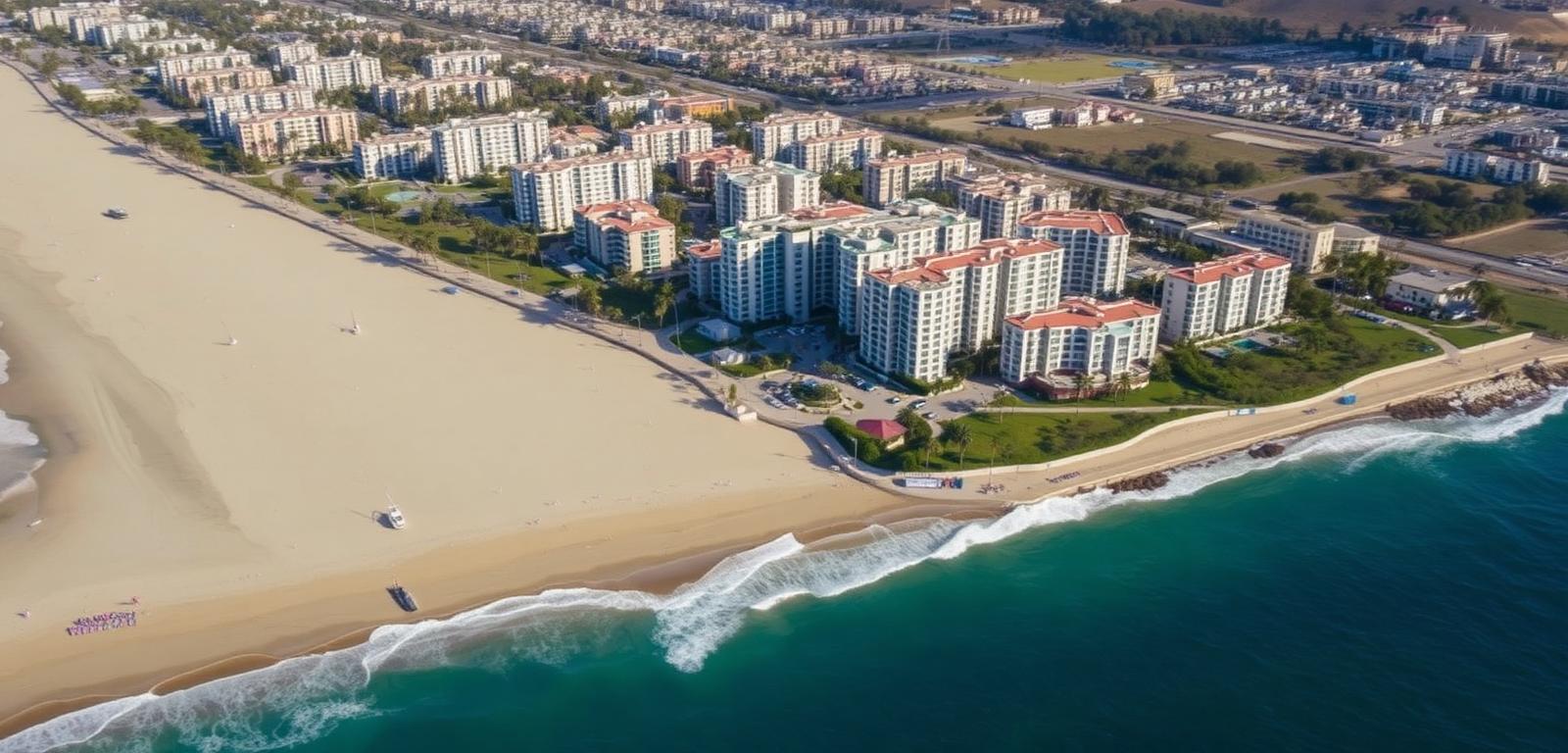
Introduction to the Westchester Multifamily Landscape
- Strategic Location: Westchester (ZIP code 90045) is uniquely positioned in Los Angeles, bordering major economic engines like Playa Vista (Silicon Beach), El Segundo, Inglewood, and LAX.
- Demographic Drivers: The tenant base is heavily anchored by Loyola Marymount University (LMU) students, university faculty, and high-earning aerospace and technology professionals.
- Inventory Profile: The market consists of a blend of vintage 1950s to 1970s apartment buildings and newer, modern Class A infill developments.
As a multifamily advisor navigating the complex terrain of Los Angeles real estate, I often tell my clients that Westchester represents one of the most strategically significant submarkets in the city. Located squarely between the booming tech hub of Playa Vista to the north and the aerospace and defense corridors of El Segundo to the south, Westchester functions as an essential bridge market. It offers a suburban, neighborhood feel while providing immediate access to some of the highest-paying employment nodes in Southern California.
For apartment owners and investors, the Westchester market has transformed dramatically over the last decade. What was once viewed primarily as a quiet, post-war bedroom community closely tied to Los Angeles International Airport (LAX) has evolved into a highly desirable destination for renters who are priced out of Santa Monica, Venice, and Playa Vista, yet still want Westside-adjacent living. The presence of Loyola Marymount University (LMU) adds a massive layer of recession-resistant stability to the area. Every year, thousands of students require off-campus housing, creating a perpetual, predictable cycle of tenant demand that sophisticated operators can leverage for premium returns.
My coverage area spans from the coastal enclaves of Santa Monica, Venice, and Mar Vista, down through West LA, Brentwood, Westwood, Culver City, and Palms, extending all the way into the South Bay communities of Manhattan Beach, Hermosa Beach, Redondo Beach, and Torrance. When comparing these diverse neighborhoods, Westchester stands out because it offers a rare combination: the high tenant quality characteristic of the Westside, paired with price points and capitalization rates that are often more accessible than the ultra-premium coastal cities.
However, operating a multifamily asset in Westchester is not without its challenges. Because Westchester is an incorporated neighborhood of the City of Los Angeles, property owners are fully subject to the city's stringent regulatory environment. Navigating rent control, transfer taxes, and tenant protections requires a proactive, highly informed approach. In this comprehensive guide, we will break down everything you need to know about the current Westchester multifamily market—from rent trends and property valuations to the local laws shaping your investment strategy—so you can make confident, options-first decisions regarding your portfolio.
Current Rent Trends and Market Performance
- Overall Average/Median Rent: Ranges from $2,650 to $3,100 per month, depending heavily on the vintage and location of the property.
- 1-Bedroom Units: Typically lease between $2,200 and $2,650 per month.
- 2-Bedroom Units: Command between $2,950 and $3,600 per month.
- Class A / Luxury Product: Newer construction routinely achieves $3,400 to $4,500+ per month.
- Occupancy/Vacancy: The submarket vacancy rate remains tight, hovering between 4.5% and 5.5%.
Understanding the rent dynamics in Westchester requires looking beyond the aggregated median numbers. Aggregated submarket rent data often blends vintage, rent-controlled stock with newer Class A developments, which can skew the perceived averages. Westchester is characterized by distinct micro-pockets. For example, the North Kentwood area, which is adjacent to sprawling single-family homes, attracts young families and established professionals who prioritize quiet, tree-lined streets. In contrast, the high-density corridors along Manchester Avenue and Sepulveda Boulevard cater heavily to LMU students, young tech workers commuting to Playa Vista, and airline personnel who need immediate access to LAX.
Currently, average rents in Westchester sit between $2,650 and $3,100 per month. One-bedroom units are leasing in the $2,200 to $2,650 range. For owners of vintage 1950s and 1960s buildings, hitting the top end of this range typically requires modern unit turns—think luxury vinyl plank flooring, updated shaker cabinets, stainless steel appliances, and, most importantly, in-unit washer and dryers. Two-bedroom units, which are highly sought after by students splitting costs and young professionals needing a dedicated home office, range from $2,950 to $3,600.
One of the most defining characteristics of the Westchester rental market is its resilience. The blended vacancy rate typically fluctuates between a healthy 4.5% and 5.5%. This is largely supported by stable enrollment figures at LMU and the continuous influx of employment opportunities in neighboring tech and aerospace sectors. When Google and Facebook expanded their footprints in nearby Playa Vista, Westchester saw a direct spillover effect. Renters who wanted to avoid the premium pricing of Silicon Beach found Westchester to be the perfect compromise, driving up demand and compressing vacancy rates.
| Submarket / Neighborhood | Average 1-Bedroom Rent | Average 2-Bedroom Rent | Estimated Vacancy Rate |
|---|---|---|---|
| Westchester (90045) | $2,200 - $2,650 | $2,950 - $3,600 | 4.5% - 5.5% |
| Playa Vista | $3,100 - $3,500 | $4,200 - $5,000 | 5.0% - 6.0% |
| El Segundo | $2,100 - $2,500 | $2,800 - $3,300 | 3.5% - 4.5% |
As the comparison table illustrates, Westchester sits comfortably in the middle tier of pricing when compared to its immediate neighbors. It offers a distinct value proposition for renters priced out of Playa Vista, while maintaining a premium over older stock in parts of the South Bay and Inglewood. For landlords, maintaining high occupancy means understanding these seasonal tenant cycles—particularly the leasing rush that occurs between May and August as students secure housing for the upcoming academic year.
Cap Rates, Valuations, and Capital Markets
- Vintage/Value-Add Cap Rates: Properties built between the 1950s and 1970s typically trade at cap rates between 4.75% and 5.50%.
- Core/Newer Construction Cap Rates: Post-2000 properties trade at tighter cap rates, generally between 4.25% and 4.75%.
- Broader Market Context: Los Angeles County average cap rates range from 5.00% to 5.85%, highlighting Westchester's premium positioning.
- Transaction Volume: Off-market activity remains key as higher interest rates limit broader market velocity.
The capital markets environment in Los Angeles has experienced significant shifts over the past twenty-four months, largely dictated by the Federal Reserve's interest rate policies. As borrowing costs have risen, we have naturally seen an upward expansion in capitalization rates across the board. However, Westchester has maintained a remarkably strong valuation profile compared to the broader Los Angeles County average.
Currently, vintage value-add properties in Westchester—typically consisting of 1950s to 1970s construction with deferred maintenance or under-market rents—are trading at cap rates between 4.75% and 5.50%. Investors are willing to accept slightly lower initial yields in this submarket because they recognize the long-term appreciation potential and the robust, localized tenant demand. In contrast, broader Los Angeles County cap rates frequently fall into the 5.00% to 5.85% range. Westchester essentially trades at a premium (meaning a lower cap rate) due to its Westside-adjacent location, strong demographic fundamentals, and proximity to major infrastructure like LAX and the newly constructed SoFi Stadium complex in neighboring Inglewood.
Newer, post-2000 construction—often referred to as Core or Class A product—trades at even tighter margins, typically between 4.25% and 4.75%. These assets attract institutional capital, family offices, and 1031 exchange buyers who are prioritizing wealth preservation, minimal deferred maintenance, and turn-key operations over aggressive value-add returns.
It is important to note that overall transaction volume across the City of Los Angeles has been relatively muted recently. The combination of elevated commercial mortgage rates and the implementation of local transfer taxes has created a bid-ask spread between buyers and sellers. This means that current cap rate ranges rely on a smaller pool of closed comparables and active listings. However, well-priced assets continue to move. For instance, my team recently closed a transaction at 5931 W 79th St in Los Angeles, CA 90045, a 3-unit property in Westchester that sold for $1,555,888. This sale demonstrates that despite macroeconomic headwinds, there is still highly active, localized capital looking to deploy into quality Westchester assets, provided the underwriting makes sense.
When providing a property valuation for my clients, I always emphasize that cap rates are just one metric. The true value of a Westchester property is deeply intertwined with its current rent roll, the extent of its deferred maintenance, its compliance with local seismic ordinances, and its positioning under local rent control laws.
Navigating the Los Angeles Regulatory Framework
- City of LA Rent Stabilization Ordinance (RSO): Applies to multi-unit properties built on or before October 1, 1978. Limits annual rent increases and governs evictions.
- AB 1482 (Tenant Protection Act): Statewide rent control applying to properties 15+ years old not covered by local RSO.
- Costa-Hawkins Rental Housing Act: Protects vacancy decontrol, allowing owners to reset rents to market rate when a tenant voluntarily vacates.
- Measure ULA (Mansion Tax): Imposes significant transfer taxes on property sales exceeding $5.15 million.
- SB 8 / SB 330: Mandates 1-for-1 replacement of protected units and requires relocation assistance during redevelopment.
Because Westchester is geographically incorporated within the City of Los Angeles, it is fully subject to municipal and state-level controls. For property owners, understanding and strictly adhering to this regulatory framework is not optional; it is the fundamental baseline of operating a profitable asset. Misinterpreting these rules can lead to significant financial penalties, delayed business plans, and diminished property values.
First and foremost is the City of LA Rent Stabilization Ordinance (RSO). This ordinance applies to most multi-unit properties built on or before October 1, 1978. During the pandemic, allowable rent increases on RSO properties were frozen entirely. However, allowable annual rent increases resumed at 4.0% (plus an additional 1-2% if the landlord pays for gas and electric utilities) effective February 1, 2024, running through June 30, 2024. Subsequent increase guidelines are tied to local Consumer Price Index (CPI) metrics. For owners of older Westchester stock, keeping meticulous track of these allowable increases is critical for maintaining cash flow in an inflationary environment.
For properties that are newer and exempt from the local RSO, the California Tenant Protection Act of 2019 (AB 1482) likely applies. This statewide law covers properties that are 15 years or older on a rolling basis. Under AB 1482, the maximum annual allowable rent increase is 5% plus the local CPI, which is capped at 8.9% for Los Angeles County for the August 2024 through July 2025 period. While AB 1482 is generally more permissive than the local RSO, it still enforces strict "just cause" eviction protections that landlords must follow.
One of the most critical pieces of legislation for property owners to understand is the Costa-Hawkins Rental Housing Act. This state law is the saving grace for multifamily investors in rent-controlled jurisdictions because it protects "vacancy decontrol." This means that when a tenant voluntarily vacates an apartment, or is evicted for a legally valid just-cause reason, the property owner has the right to reset the rent for that unit to the current market rate. Given the massive disparity between long-term, rent-controlled leases and current market rates in Westchester, capturing the upside of a vacancy is the primary driver of property appreciation.
Additionally, any investor looking to sell a multifamily property in Westchester must heavily factor Measure ULA into their exit underwriting. Commonly known as the "Mansion Tax," Measure ULA is a City of Los Angeles documentary transfer tax that applies to all real estate sales above certain thresholds. For 2024, the tax imposes a 4.0% gross levy on transactions between $5.15 million and $10.3 million, and a 5.5% tax on transactions over $10.3 million. Crucially, this tax is applied to the gross sales price, not the net profit. For owners of large apartment complexes in Westchester, this tax can easily strip hundreds of thousands of dollars from the net proceeds of a sale, making proactive tax strategy absolutely essential.
Lastly, owners exploring redevelopment or significant property alterations must be aware of SB 8 and SB 330 (The Housing Crisis Act). These laws mandate one-for-one replacement of protected or rent-controlled units if a property is demolished, and they require substantial relocation assistance for displaced tenants.
Value-Add Strategies for Westchester Owners
- By-The-Bed & Student Arbitrage: Optimizing 2-to-4-bedroom units for LMU students through split leases or turn-key furnished setups.
- WFH & Tech Upgrades: Upgrading units with in-unit laundry, gigabit internet, and dedicated home office nooks for Silicon Beach professionals.
- ADU Additions: Utilizing state laws to add Accessory Dwelling Units to existing parcels to boost overall net operating income.
- Submarket Positioning: Tailoring the property's aesthetic and amenity package to the specific micro-neighborhood demographic.
Given the high cost of debt and the restrictive regulatory environment, standard "buy, renovate, and flip" strategies have become much more difficult to execute in Los Angeles. Instead, long-term Westchester property owners must look toward targeted, operational value-add strategies to increase their yields. The unique demographic makeup of Westchester provides several distinct avenues for maximizing rent rolls without undertaking massive, structural renovations.
One of the most lucrative strategies in this submarket is targeting the "by-the-bed" or student housing arbitrage. Because Westchester is home to Loyola Marymount University, there is a constant demand for housing from students who prefer to live off-campus. Owners of properties with large, multi-bedroom units (2 to 4 bedrooms) can often generate significantly higher gross rents by leasing out units on a per-bed basis, rather than as a single traditional apartment. Offering furnished, turn-key setups with individual leases per bedroom reduces friction for students and their guarantors (parents), and commands a distinct premium. Even if you prefer not to lease by the bed, simply optimizing a large dining room or den into a legal additional bedroom can dramatically shift the financial profile of the property.
For properties catering to the Silicon Beach tech demographic, the focus should be on practical, lifestyle-oriented upgrades. The modern tech professional commuting to Playa Vista or El Segundo highly values convenience and connectivity. If there is one amenity that justifies a massive rent premium in vintage 1950s and 1960s buildings, it is the installation of in-unit washers and dryers. Additionally, optimizing units for remote work by installing built-in desk nooks, ensuring the building is wired for high-speed fiber internet, and updating common areas to feel modern and secure will quickly attract higher-paying, highly qualified tenant profiles.
Another highly effective value-add strategy is the development of Accessory Dwelling Units (ADUs). The State of California has passed aggressive legislation limiting local municipalities' ability to block ADU construction. For owners of Westchester multifamily properties with excess land, large garages, or underutilized carports, converting these spaces into studio or one-bedroom ADUs is an incredible way to add new, non-rent-controlled units to your property. Because ADUs are new construction, they are typically exempt from the local RSO under Costa-Hawkins, allowing owners to capture full market rent and boost the overall valuation of the property without triggering Measure ULA on the existing baseline value.
Strategic Exit Options and Next Steps
- Measure ULA Mitigation: Structuring sales via partial-interest transactions, master leases, or well-timed 1031 exchanges to avoid transfer tax traps.
- Portfolio Restructuring: Trading out of highly regulated City of LA assets into nearby, less-regulated South Bay markets.
- Hold and Refinance: Leveraging accumulated equity to improve the property or acquire additional assets without selling.
As a multifamily advisor, my approach is always no-pressure, advisory, and options-first. There is no "one-size-fits-all" strategy for Westchester property owners. The right move depends entirely on your specific investment timeline, your tolerance for navigating Los Angeles city regulations, and your overarching wealth-building goals.
If you are planning an exit in the $5 million-plus range, you must absolutely account for Measure ULA in your disposition underwriting. Triggering a 4.0% or 5.5% gross transfer tax can severely impact your net proceeds. To navigate this, we often explore alternative disposition strategies with our clients. This might include partial-interest transactions (selling the property in tranches below the threshold), implementing master leases, or adjusting the timing of a 1031 exchange to ensure the financial mechanics still align with your goals.
Many of my clients who are fatigued by the City of Los Angeles regulations choose to execute a 1031 exchange, trading their Westchester assets for properties in nearby, less regulated municipalities. Markets like El Segundo, Manhattan Beach, Hermosa Beach, Redondo Beach, Torrance, Hawthorne, Gardena, Lawndale, Lomita, Carson, and the Palos Verdes Peninsula offer robust tenant demand without the heavy burden of the LA City RSO or Measure ULA. Moving capital just a few miles south can dramatically simplify property management and improve long-term cash flow predictability.
On the other hand, holding your asset might be the most prudent choice. By executing strategic tenant buyouts, completing unit renovations, or adding ADUs, you can force appreciation and eventually refinance the property, pulling out tax-free capital to expand your portfolio elsewhere.
If you own multifamily property in Westchester and are curious about how these market dynamics impact your specific building, I invite you to reach out. We can schedule a confidential, complimentary strategy session to review your rent roll, analyze your property's current position in the market, and explore all the strategic options available to you in today’s evolving real estate landscape.
Frequently asked questions
Is Westchester subject to Los Angeles rent control?
Yes. Because Westchester is an incorporated neighborhood within the City of Los Angeles, properties built on or before October 1, 1978, are subject to the City of LA Rent Stabilization Ordinance (RSO). Newer properties may still be subject to the statewide AB 1482 rent caps.
What is the average cap rate for a multifamily property in Westchester?
Currently, vintage or value-add properties in Westchester trade between 4.75% and 5.50% cap rates. Newer, core construction typically trades at tighter cap rates ranging from 4.25% to 4.75%.
Does Measure ULA apply to properties sold in Westchester?
Yes. As part of the City of Los Angeles, multifamily property sales in Westchester exceeding the current thresholds (roughly $5.15 million for 4% and $10.3 million for 5.5%) are subject to the Measure ULA transfer tax, calculated on the gross sales price.
Why is tenant demand so high in the Westchester submarket?
Westchester benefits from a diverse tenant base driven by students and faculty from Loyola Marymount University (LMU), as well as highly paid tech and aerospace professionals working in adjacent Silicon Beach (Playa Vista) and El Segundo.
RELATED READING